
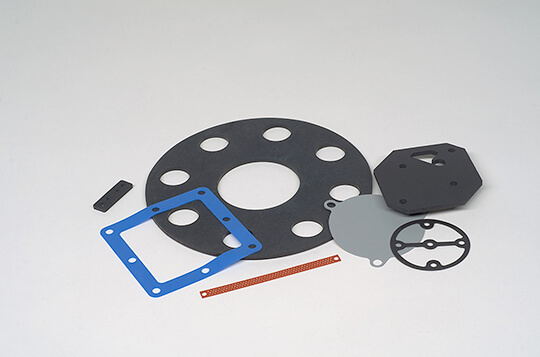
Viton® Gaskets: For High Temperature, Chemical and Fuel Resistant Sealing Applications
When an application involves fuels, hot oils, steam, or temperatures or aggressive chemical exposure that break down standard elastomers, engineers reach for Viton®. Commonly used in demanding environments due to its heat and chemical resistance. Excelsior is a Viton® gasket manufacturer with over a century of converting experience, stocking multiple grades of FKM material and cutting parts to your specifications in any volume from prototype to full production.
Why Choose Viton® (FKM)?
Viton® is the registered trademark of Chemours, originally developed from DuPont, for a family of high-performance fluroelastomers (FKM). It is among the highest-grade fluoroelastomers in commercial sealing applications. It is often selected when lower-cost rubbers cannot survive the operating environment.
Where Viton® earns its cost:
- Continuous service ranges from approximately -20°F to +400°F, with short excursions higher depending on grade and compound.
- Strong performance against fuels, oils, hydraulic fluids, many solvents, and a wide range of acids.
- Steam and hot water resistance in appropriate grades.
- Tensile strength that holds up under mechanical stress and repeated compression cycles.
- Low compression set to maintain seal integrity over long service intervals.
- Resistance to ozone, weathering, and UV exposure, which makes Viton seals and gaskets suitable for outdoor and demanding environmental applications.
If your application falls within the performance rangeof EPDM, nitrile, or neoprene, those compounds are usually the better economical choice. Viton® is the right choice when higher temperatures, aggressive chemicals, fuels or oils exceed the capabilities of standard elastomers.
Viton® Material Offerings
Viton® is offered in several base polymer grades. Each grade is engineered for a different balance of chemical resistance, fuel compatibility, temperature performance, and low-temperature flexibility, and steam compatibility. Specifying the correct grade for your application is the single most important step in getting long service life from a gasket made from Viton®.
Viton® A
The general-purpose grade and most widely used FKM grade. Excellent resistance to a wide range of fluids, oil, and chemical sealing applications. Approximately 66% fluorine content, which makes it a strong choice for a wide range of products.
Viton® B
Contains a higher fluorine content (approximately 68%) and offers improved fluid, oil and other chemical resistance compared to Grade A. Commonly specified for applications with more aggressive fuels, oxygenated fuel blends, and demanding chemical environments.
Viton® F
The highest fluorine content (approximately 70%) of the three common grades. Specified for the most aggressive fuel blends, chemicals, methanol, and oxygenated automotive fuels where Grades A and B may be insufficient.
Generic FKM
We also stock generic FKM compounds that match many of the properties of branded Viton® at a lower price point. For programs where cost sensitivity is a factor and the branded specification is not contractually required, generic FKM is often a sound substitution. Our gasket specialists can review your spec and recommend it.
Not sure which grade fits your application? Send us your service conditions (media, temperature, pressure, duty cycle) when you request a quote and we will recommend a grade and a hardness.
Manufacturing Viton® With Excelsior
Viton® is a demanding material to convert well. It is generally harder to cut cleanly than nitrile or EPDM, requiring proper tooling and process control to maintain dimensional accuracy. Clean edges and consistent part quality are important for reliable sealing performance.
Our Viton® conversion processes include:
- Waterjet cutting for thicker stock, complex geometries, and parts where heat-affected edges are unacceptable.
- Laser cutting for tight tolerances on thin stock.
- High-speed knife cutting for medium-volume production with clean edges.
- High-volume die cutting for established production programs where tooling is justified.
- Medium and low-volume die cutting for prototype runs and short production batches.
- Lathe cutting for washers, and ring-shaped parts cut from extruded or molded tube stock.
- Peel-n-Stick for PSA-backed parts that ship on a liner.
- Vulcanizing of extruded Viton® profiles into closed-loop gaskets, an alternative to molded o-rings for larger diameters.
- Pressure-sensitive adhesive lamination for assembly applications.
We match the manufacturing process to the part geometry, the tolerance requirements, and the run quantity. The goal is the highest-quality part at the lowest cost the program will support.
Get a Viton® Gasket Quote
Excelsior has been a Viton® gasket manufacturer since FKM came into commercial use, and we have been a custom converter of precision sealing components since 1916. Whatever the application, our team can recommend the right grade, the right durometer, and the right manufacturing process to fit your program. Request a quote on your Viton® gasket today.
Frequently Asked Questions About Viton® Seals and Gaskets
How does Viton® perform at low temperatures?
Standard Viton® compounds become stiff below approximately -20°F and lose sealing reliability as the temperature drops further. For applications that see colder service, low-temperature FKM grades such as GFLT or GLT extend the usable range down to roughly -40°F.
Is Viton® suitable for FDA or potable water applications?
Standard Viton® compounds are not FDA-compliant. FDA-grade FKM compounds exist and can be sourced for food contact, beverage processing, and pharmaceutical applications. If your application requires NSF 61 potable water certification, EPDM is more commonly specified and stocked, and we can advise on the right path during quoting.
Can Viton® be bonded or co-cured with other materials?
Yes. We can apply pressure-sensitive adhesive backing to the Viton® sheet for assembly applications. For mechanical bonding to metal substrates or other elastomers, we work with bonded-rubber suppliers and can include those operations in a quoted assembly.


