
Benefits
- Cut thickness of material
- Cut width of material
- Coil material
- Apply adhesives
Your browser is out of date.
You are currently using Internet Explorer 7/8/9, which is not supported by our site. For the best experience, please use one of the latest browsers.

Silicone is a commonly used gasket material and is most known for its low and high temperature rating (-80 to +450F), resistance to weathering, resilience to fuels, and inertness to oils. This material group is used for a wide-range of applications including food, automotive, medical, aerospace, defence, electronics, and more.
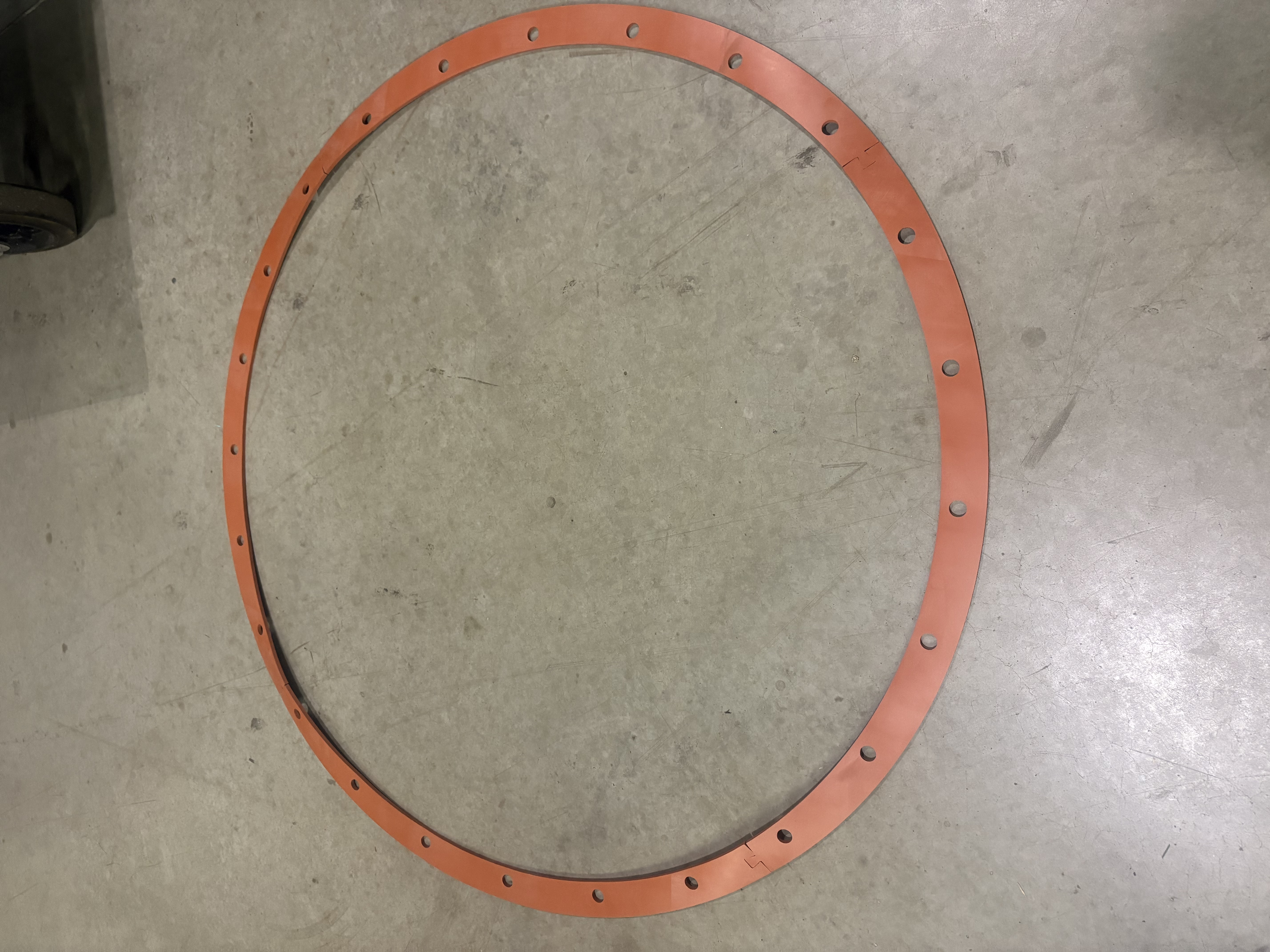

We manufacture silicone for applications across multiple industries. Our offerings include:
This cost-effective and general-purpose elastomer can handle standard industrial and mechanical environments, though specialized cases should rely on certified elastomers for the specific application area.
FDA-approved silicone (also known as FDA-compliant silicone) is for applications where repeated contact with food will occur. This material follows the standards set by FDA Regulation 21 CFR 177.2600 and is cured for high-purity with very low risk of chemical migration.
Electrically-conductive silicone is a blend of silicone and another material such as carbon or conductive metals that retains the elastomer properties of the silicone and the conductive properties of the inclusion. Typical applications see parts that are compressed until the conductive material forms a pathway for electricity to follow, such as in pressure sensors and touchscreens.
Fiberglass-reinforced silicone brings additional mechanical strength to the silicone, improving its resistance to stretching, compressing, weathering, UV, and exposure to petrochemicals and oils.
Medical-grade silicone is for applications with repeated or constant contact with human tissue, skin, oils, or other bodily fluids. Manufactured according to standards such as USP Class VI and ISO 10993 for biocompatibility and chemical stability so it remains inert and intact throughout its lifetime.
Fluorosilicone (FVMQ) is a synthetic elastomer that combines the inert, stable, and generally resistant capabilities of silicone with additional resistance to oils, solvents, and fuels. Parts manufactured from this material are used in areas such as aerospace and defence and the automotive industry.
Silicones have different types based on the material’s chemical and molecular architecture:
Silicone is a synthetic rubber (elastomer). Many applications of silicone use the material as a medium that behaves like both a rubber and a plastic.
We manufacture silicone in a number of different ways including waterjet, flash-cut, lathe-cut and a number of die cutting methods. We can match the part design and quantity with the correct manufacturing process to yield the highest quality, lowest cost part possible. We can also apply pressure-sensitive adhesive to this material.


